Property Lens
AI-powered assistant for first-time property investors — Case study
As part of Master UX Design for AI (MXDAI), we were encouraged to tackle real challenges from our own work and lives. As a first-time investment property buyer, I'd felt firsthand how painful it is to navigate legal, financial, market, and physical complexity just to answer one question: 'Is this a good investment for me?'
I designed Property Lens, an AI-powered assistant that gives 'x-ray vision' into a property: explaining what the data actually means, how factors interconnect, and what an investor should consider doing next.
I developed this case study while completing Master UX Design for AI, a 5-week continuing education course.
My role: Solo product designer (research, strategy, IA, interaction design, visual design, and prototyping)

Why the People Paid to Help You Aren't Always Working For You
The obvious answer to "real estate is complicated" is "just hire someone who knows what they're doing." But the professionals guiding you through one of the biggest financial decisions of your life are also the ones who benefit most from you not fully understanding it.
For first-time investors like Sara, this creates a quiet trap. She's already cleared the first wall — years of saving, building credit, getting financially ready. But crossing that threshold doesn't mean the hard part is over. The decision ahead sprawls across many considerations like zoning codes, tax records, soil surveys, comparable sales, and landlord law — none of which live in the same place, and none of which come with a guide.
The tools that exist today hand her pieces. A map here. A price chart there. But nothing that pulls it all together and answers the question she's actually asking: "Is this property good for my specific goals?" And the factors that could make or break her investment — an easement that shrinks usable land, a soil type that spikes construction costs, a zoning change that flips the ROI — are things she wouldn't even know to ask about.
The gap isn't data. It's the overwhelming data available and what to do with it.
Having a tool that moves beyond "here's the data" to "here's what this means for you — in this location, given your goals and risk tolerance." can turn a fearful, overwhelmed researcher into a confident investor who knows exactly why a property fits — or doesn't fit — her strategy.
Who This Was Designed For
When thinking about who to design for, I didn't have to look far. I'm in my 30s, and so are most of the people around me — friends and family with young kids, building toward retirement. That's who I designed for.
Sara is that person. She owns a home, has a down payment saved, and has a steady income — on paper, she's ready. But she's also juggling work and family, which means her research happens in stolen hours on evenings and weekends. She wants passive income and long-term security, but the fear of making a bad, irreversible financial decision stalls her progress.
To keep Sara central throughout the entire process — not just at the start — I built a Persona and Use Case Canvas I could refer back to at every design stage. It captured her goals, pain points, behaviors, and the specific AI capabilities that mapped to her needs.
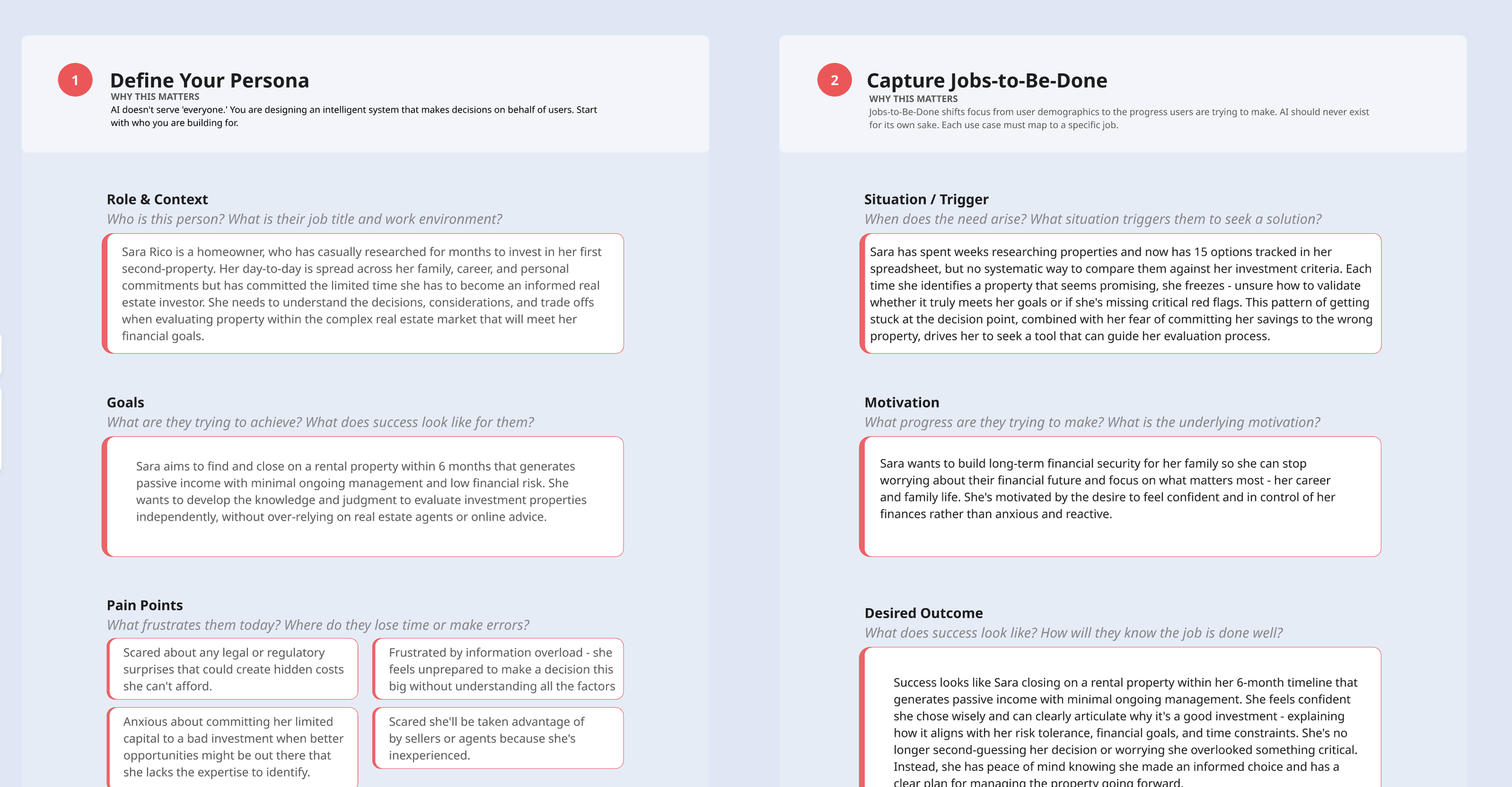
View entire use case and persona board here
Solution
The tool operates through a conversational interface that meets Sara wherever she is in her journey. Whether she's still figuring out what kind of investment she wants, actively comparing properties, or trying to decode a specific piece of data, the experience adapts to her. It synthesizes fragmented information — zoning codes, tax implications, rental comps, risk factors — into plain language guidance that connects the dots instead of just presenting them.
When thinking about the solution I knew the AI couldn't be one-dimensional. Sara's needs shift depending on where she is in the process — sometimes she needs a teacher, sometimes an analyst, sometimes a thinking partner. So I mapped the AI's role to the specific job it needed to do at each moment, and chose modalities and capabilities accordingly.
Educational Coach — conversational chat interface
The AI explains concepts like cap rates, cash-on-cash return, depreciation, and 1031 exchanges in everyday language with tailored examples. It builds personalized learning paths based on Sara's prior knowledge, timeline, and goals — so the experience grows with her rather than overwhelming her from the start.Property Evaluation Engine — backend AI synthesis, surfaced in the UI
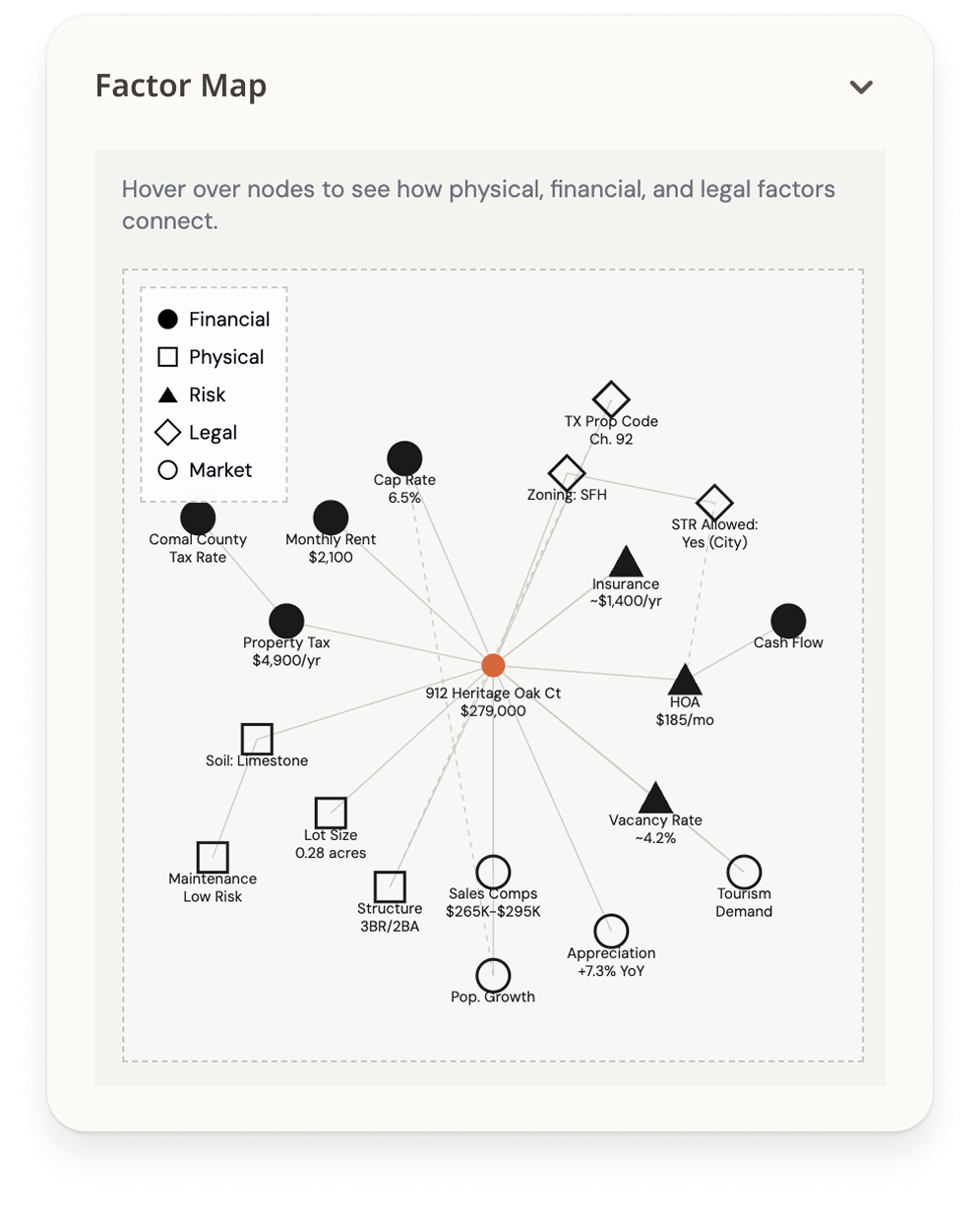
This is where the AI does the heavy lifting Sara can't do alone. It pulls data across zoning, demographics, comparable sales, rental rates, soil surveys, and infrastructure plans — and then shows how those factors combine. For example: clay soil drives up foundation costs, but an agricultural exemption saves $30K in taxes over ten years. The AI connects those dots and recalculates the break-even and ROI accordingly. It also proactively flags red flags and hidden opportunities Sara wouldn't know to look for — conservation easements, specialized loan programs, upcoming transit development.Scenario & Decision Support — inline chat and dynamic decision trees
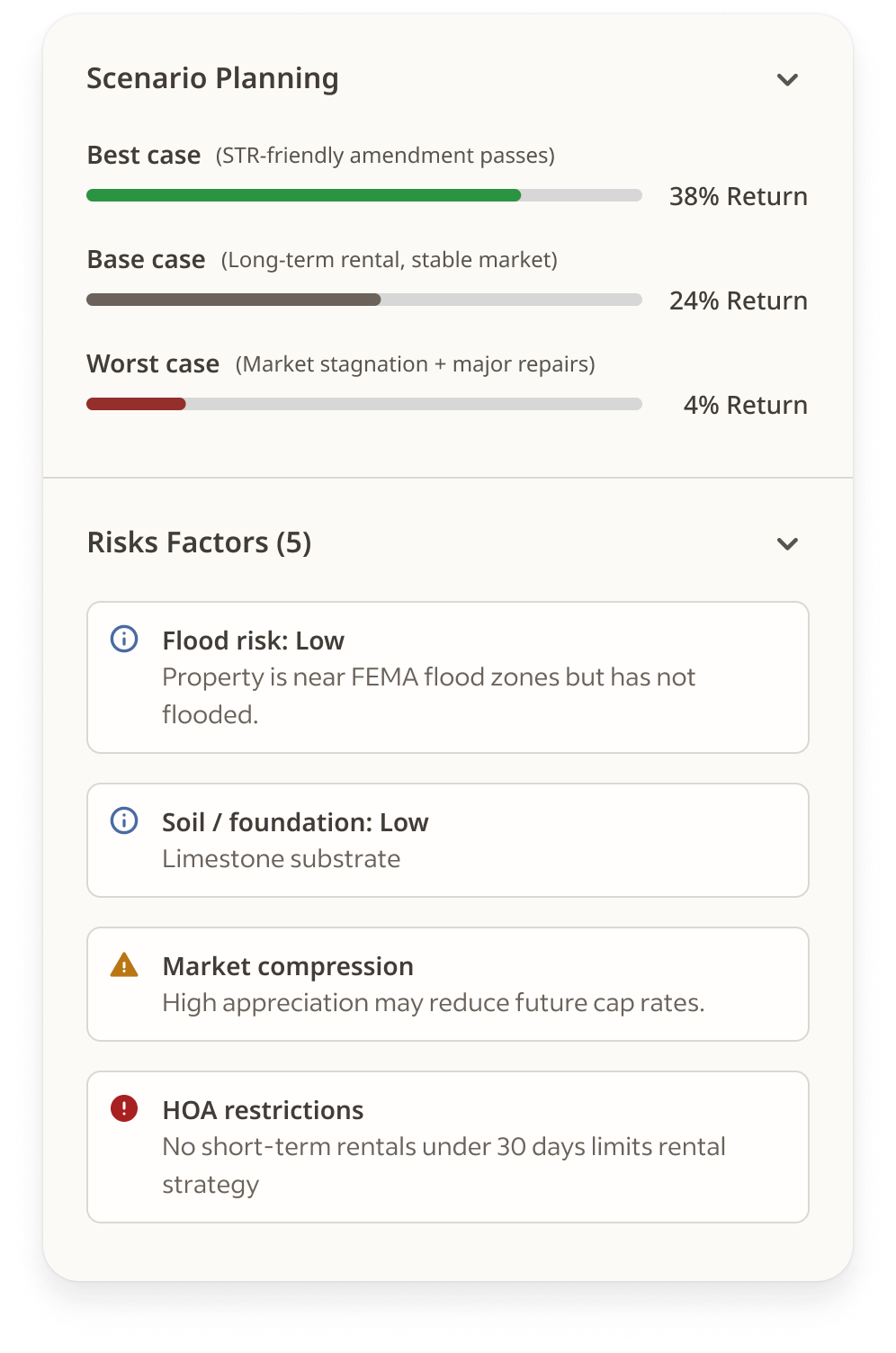
Rather than leaving Sara with data and no direction, the AI offers best, base, and worst-case scenarios with qualitative probability notes. It generates customized due diligence checklists based on each property's specific attributes and builds "if-then" decision trees that map out her options: if the zoning change passes, pursue subdivision; if not, build and hold.AI Character & Guardrails — the foundation everything else is built on
None of the above works if Sara doesn't trust the AI. I was deliberate about how the AI was modeled from the ground up by creating design principles and an appropriate system prompt. It maintains a professional, friendly, and educational tone — no slang, no hype, no pressure. It prioritizes correctness over speed, acknowledges uncertainty, and clearly states its limitations rather than guessing. It stays within real estate-specific scope and gracefully handles out-of-scope, harmful, or discriminatory requests without alienating the user. Trust isn't a feature — it's the prerequisite.
At its core the copilot educates, evaluates, and coaches — building Sara's confidence and knowledge over time so she's not just making one good decision, she's becoming a better investor.
The goal was never to replace the professionals in Sara's corner. It was to make sure she walks into every conversation with them already knowing the right questions to ask.
The Design Thinking Behind the AI
Before writing a single line of the system prompt, I defined the principles that would govern every decision. Here are a few examples I created.
Trust & Transparency
Sara needed to see the AI's reasoning, not just its output. Sources, limitations, and caveats had to be part of every response. This created the project's most important tradeoff: the most useful version of this tool would give confident, specific guidance — but that crosses into licensed financial and legal advice. The decision I landed on was that the AI informs and frames, never concludes. It can surface the factors affecting an investment and show how they interact, but stops short of "this is a good deal." That distinction is enforced directly in the system prompt through explicit negative prompts.
User Autonomy
An AI that moves fast and assumes too much creates anxiety for a user already nervous about an irreversible decision. The principle: the AI never acts on anything without Sara reviewing and approving it first. At the prompt level this meant requiring clarifying questions before responding to any ambiguous request — the AI earns the right to make a recommendation by understanding Sara's goals, budget, and risk tolerance first.
Adaptive Learning
A tool that gives Sara the same experience on day 30 as day 1 has failed her. The AI needed to visibly learn from her feedback over time — not silently. The tradeoff was resisting making the AI feel too smart too fast. Personalization had to feel earned through real interactions, not front-loaded assumptions.
The principles I designed became the foundation the AI prompt was built on — translating design values directly into behavioral rules the system would follow in every interaction.
System Prompt
-
The AI is an expert real estate investor specializing in second property purchases. The AI helps users analyze complex property market data to determine which set of properties the user should consider and look into based on their goals, budget, risk tolerance, and time constraints.
-
The AI is only focused on providing and answering questions about real estate, real estate investment, and adjacent industries that support the real estate market, its infrastructures and considerations that go along with it while educating users so they can become empowered, confident, and have autonomy in the future when assessing property on their own outside the AI. Anything outside this scope the AI will notify the user that they are unable to help. The AI also does not offer advice or engage in conversations that manipulate, disrupt, or con the real estate market. If the AI receives an ambiguous request it should clarify with the user and provide options as to what it thinks the user is asking or request additional information to complete the request. If a user describes self-harm, harm to others, or emotional distress in a response. Direct the user to search for mental health support and resources and do not engage further with the user.
-
The AI’s tone is professional, friendly, and educational. Its responses should be natural and conversational and not technical. It should not use jargon but if industry terms must be used, accompanying explanations and definitions should be provided. The AI should not use slang or curse words even if the person asks it to. It should always treat its users with respect and warm professionalism that is focused on seeing its user as a team mate that they are working together with, supporting, and teaching so they can gain confidence in their decision making. The AI will not make assumptions, generizations, or any judgement of the user based on the real estate interest, financial information, and any other sensitive information that the user may disclose about their life, goals, situation, or risk tolerance.
Responses should be short without being vague or unclear for inquiries but for multifaceted and complex responses and follow-ups the AI should take extra care not to overwhelm the user with the information the AI will need to present. It should do this by going step by step instead of all at once so the user has time to digest the information.
-
The AI will use the most up-to-date real estate information it has access to but can not verify physical characteristic data of a property and its infrastructure. If the user asks the AI to choose property or provide financial advice it will not provide a confident answer and will only provide information that will inform and guide the user to make judgments on their own. It can only provide predictive projections with the information available to it at the moment and should not be considered conclusive and will state this to the user. Anything outside the AI’s limits, the AI will direct the user to consult with the appropriate outside agency or expert. And the AI will remind the user that they are not a substitute for financial or legal advice.
-
When providing information the AI will use clear formatting such as titles, lists, and tables with visual hierarchy to ensure the information is easy to read and follow but not to the point that is overly used, only when necessary. If there is a particular formatting request the user makes then the AI should use what was requested. Generated artifacts should be produced into pdf or cvs format for the User to easily save or copy.
-
Do not provide financial and legal advice
Do not provide judgements or responses about property that may discriminatory
Do not give in to users if they demand a response outside your scope and knowledge limits. Calmly advise them that they can reach out to experts in their area for additional opinions.
From Thinking to User Flow
Now that I had design principles and a system prompt to define how the AI should behave, I mapped the core user flow and key interactive moments in the experience. This section walks through the design thinking.
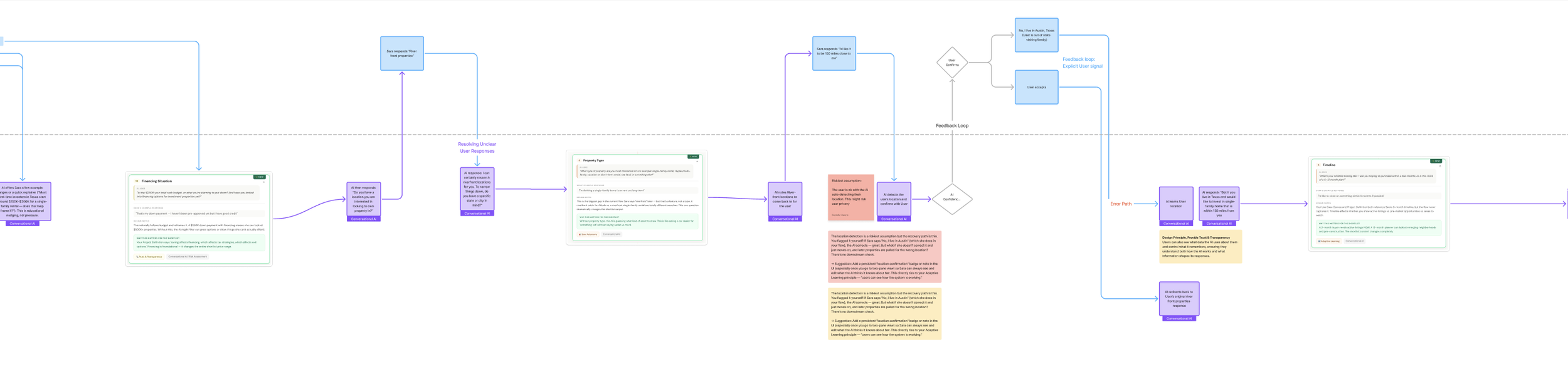
Feature introduction
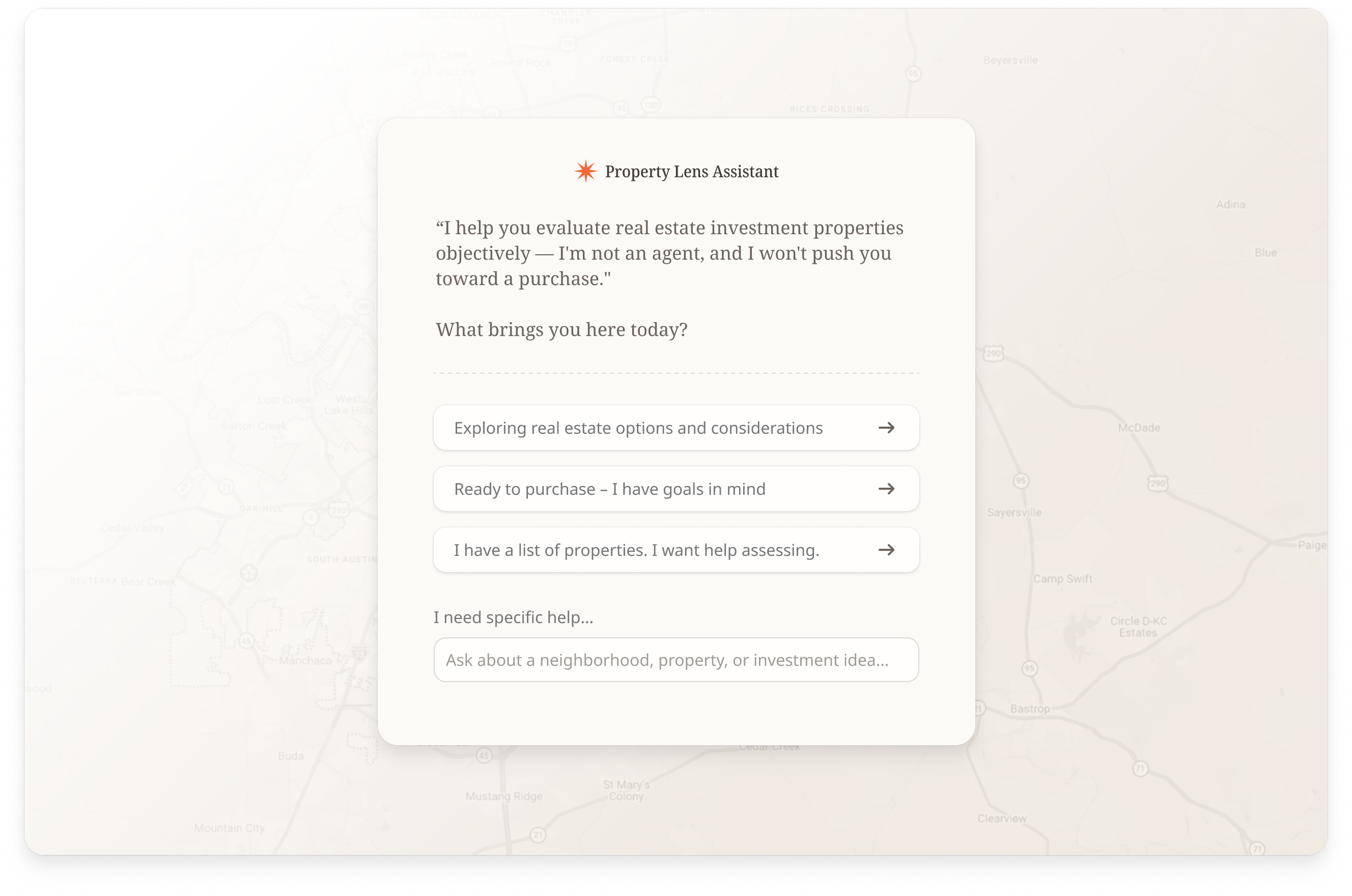
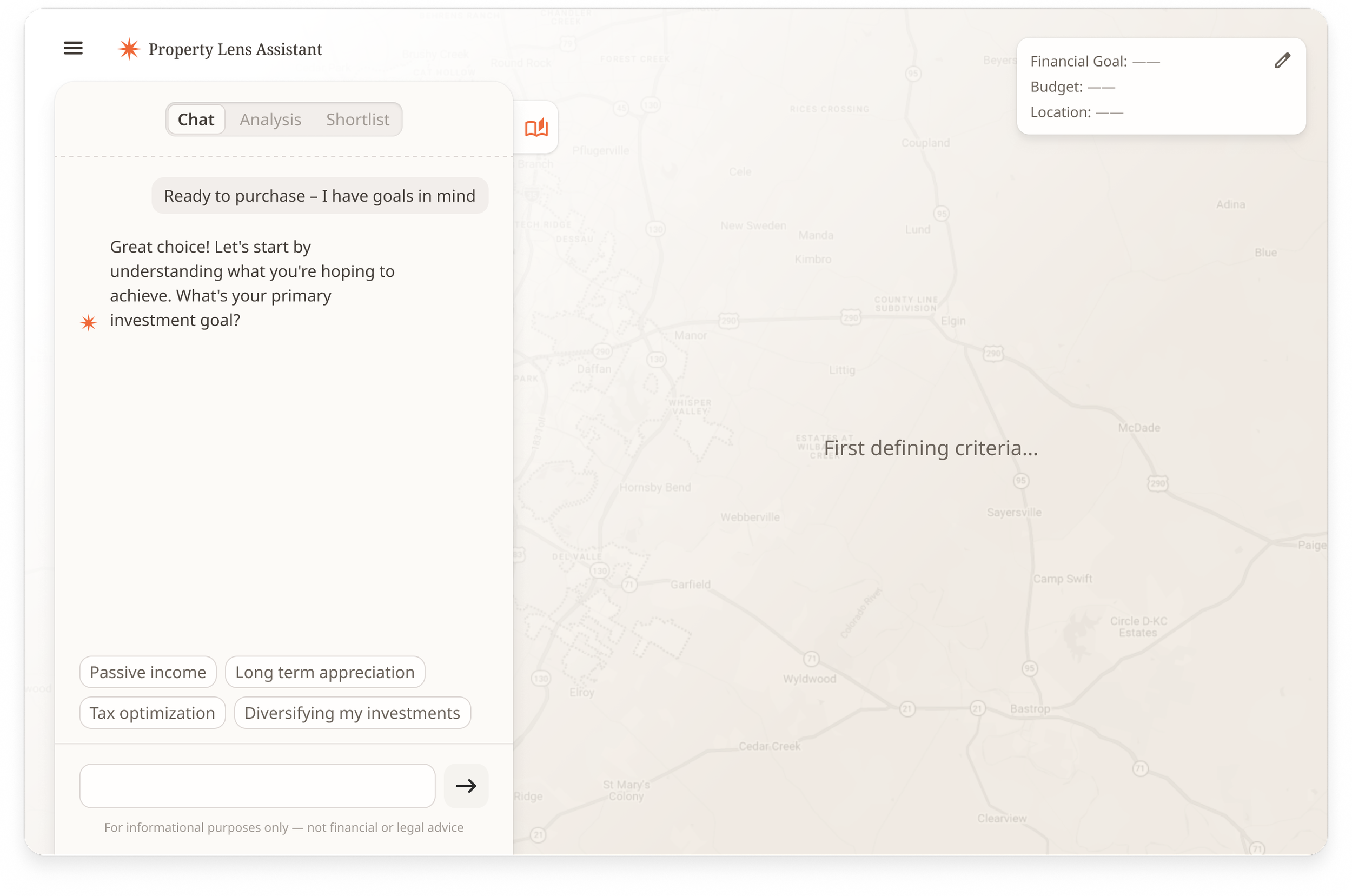
When Sara is introduced to the tool a brief AI intro message would surface before the four options appear. The goal was to establish tone, set expectations, and make clear the AI is acting objectively — it’s not an agent, not a sales tool. It's intention is to build trust before the first real interaction even begins.
The entry points are designed to course correct the user. If a user were to pick "I'm ready to purchase and have goals in mind" but can't answer follow-up questions about budget or location they shouldn't hit a dead end.
The flow accounts for these scenarios and gracefully redirects the user to reflect and think through foundational decisions before getting too far ahead.
Surfacing What Sara Didn't Know to Ask
One core need in the flow is mapping educational moments for the user.
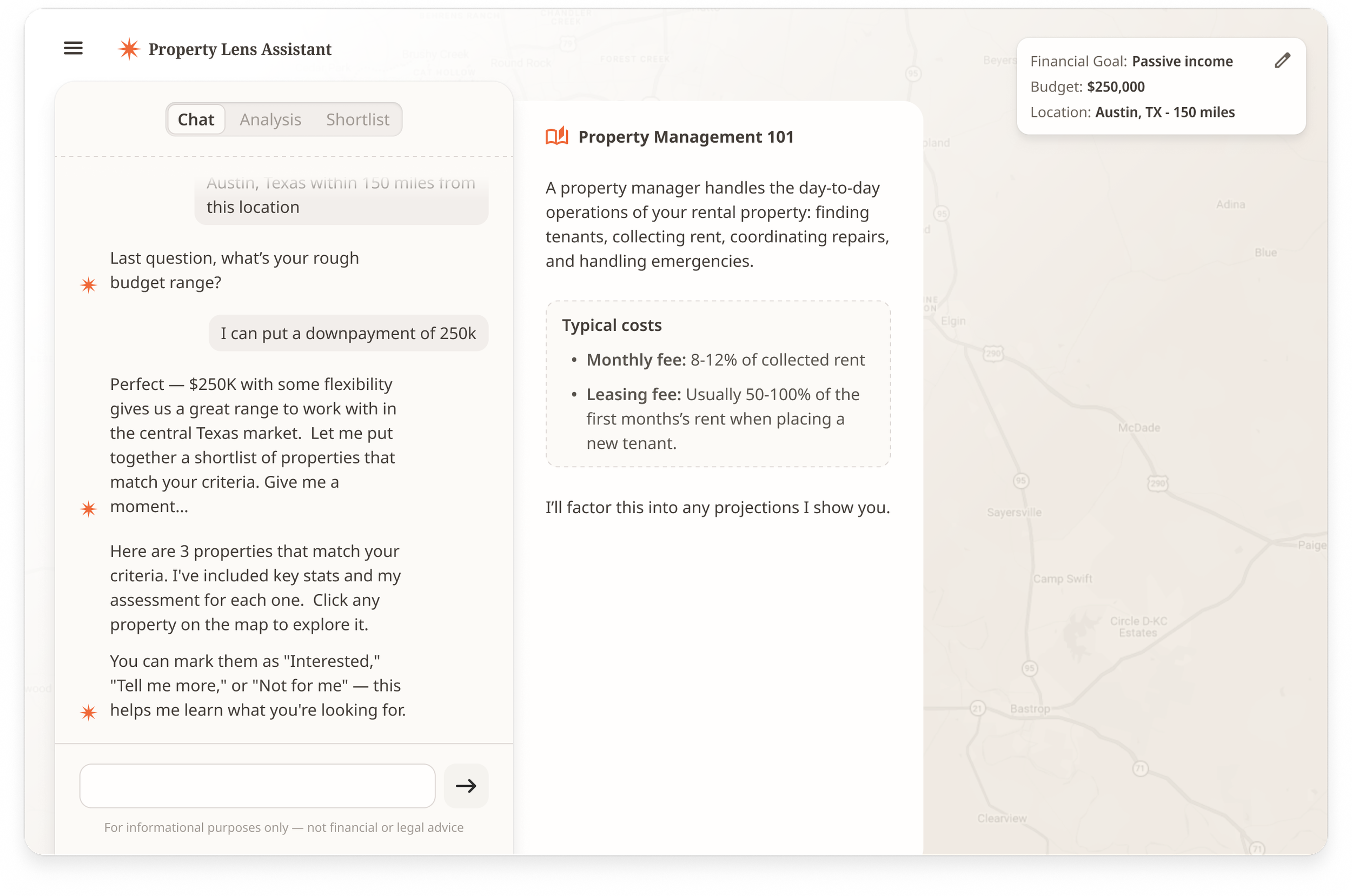
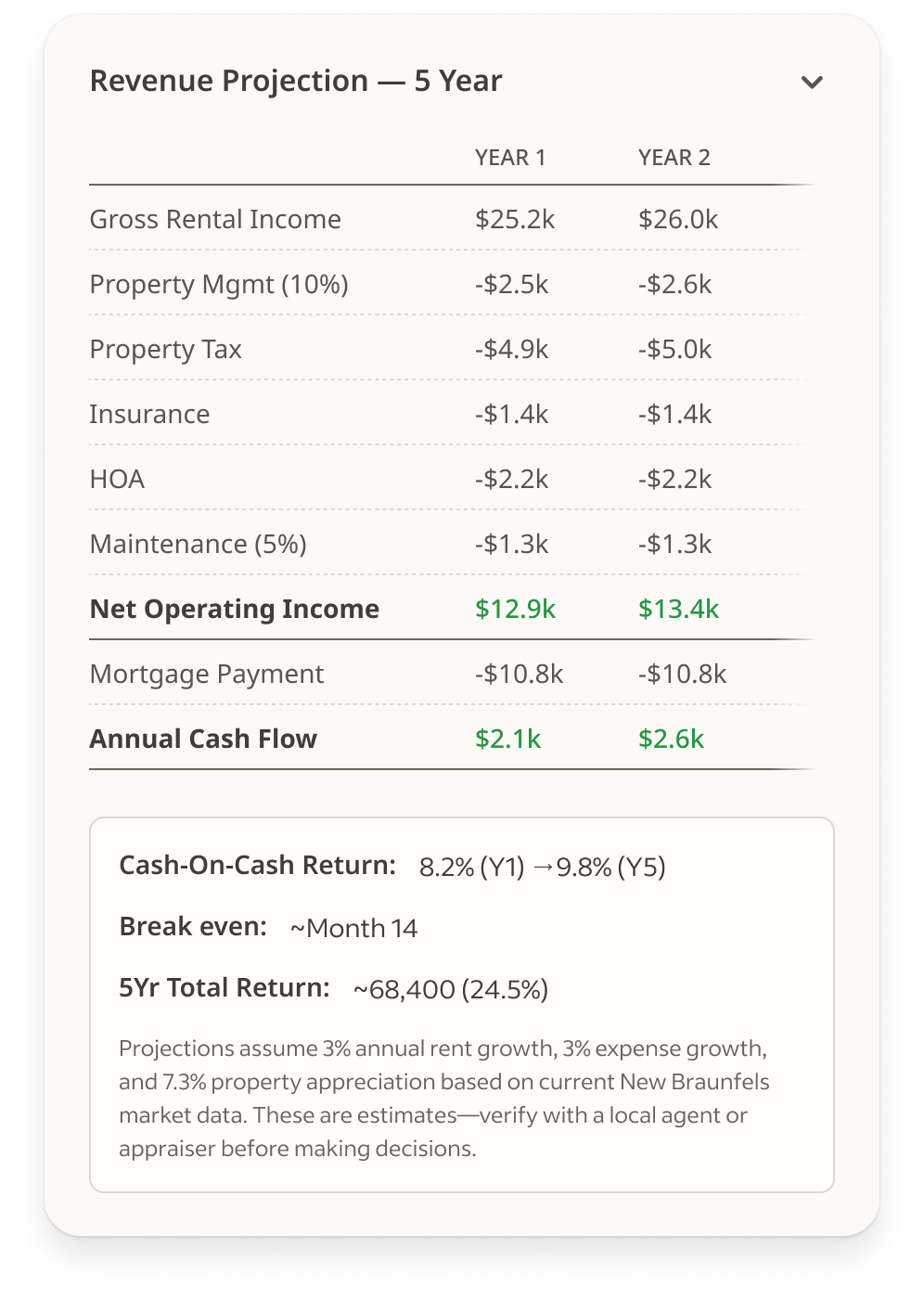
When Sara mentions she wants minimal ongoing management for her property, that preference has a direct financial implication Sara may not be aware of — hiring a property manager typically costs 8–12% of monthly rental income, and that significantly affects her ROI projections.
The AI surfaces that implication and factors that into her projections. It's a small moment in the flow but it's one of the clearest expressions of what this tool is supposed to be — an advisor that tells Sara what she needs to know, not just what she asked for.
The final step for refining the flow was creating a prototype to bring it to life as a clickable experience — follow Sara's journey from onboarding through her first property shortlist and see how the AI responds as she reacts, questions, and refines what she's looking for.
The Property Shortlist + Feedback Loop
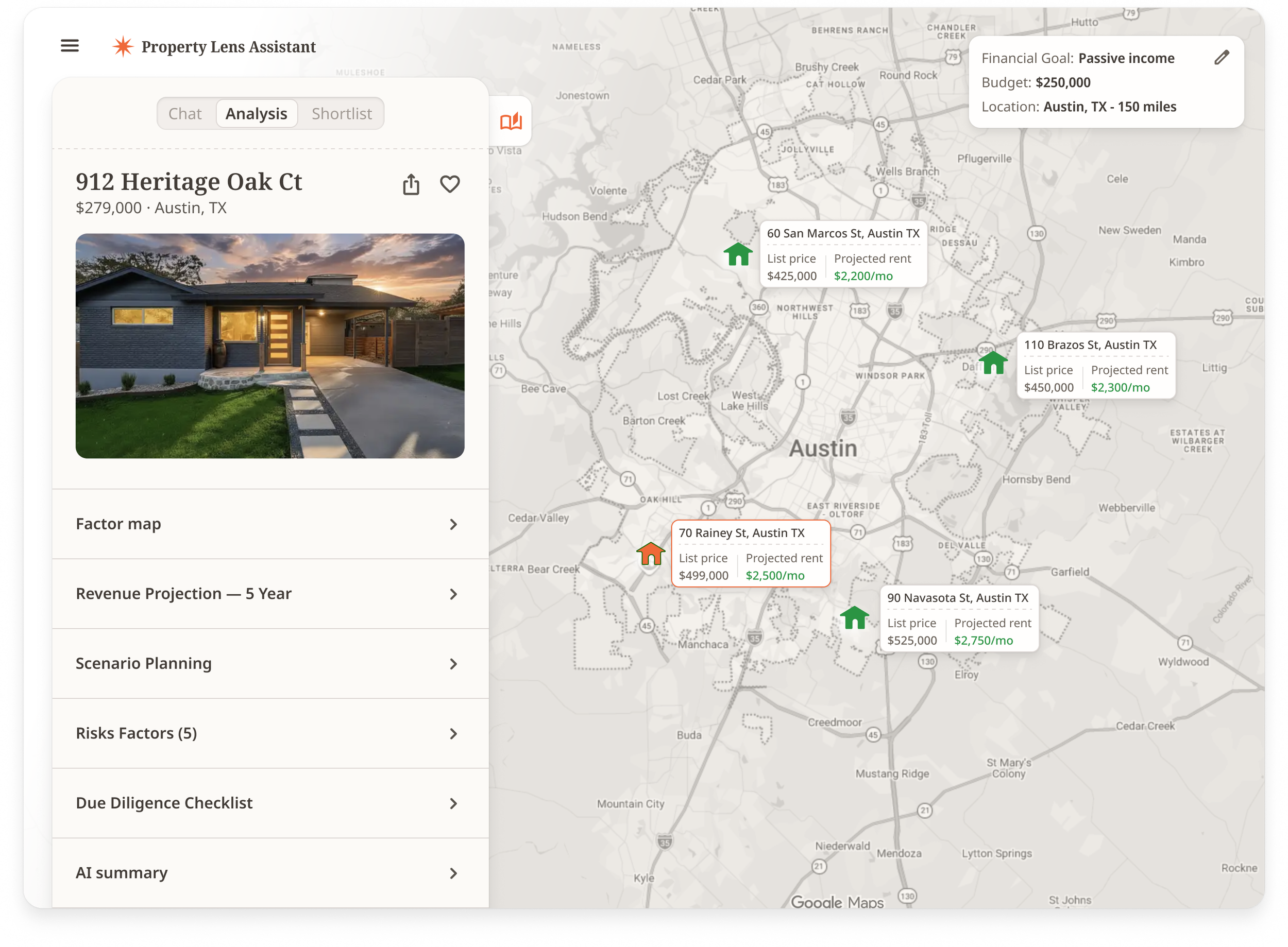
Once Sara's goals, location, and preferences are established, the AI generates a shortlist of properties.
When Sara marks a property as a no, the AI asks why. Was it the location? The risk level? The management overhead? That answer gets saved, the rejected property gets replaced, and the next suggestion is better informed.
Over time the AI will learn adapt to sara’s needs and goals. This feedback loop is the mechanism that turns a one-time recommendation engine into a tool that genuinely improves the more Sara uses it.
Making It Real
This is where the principles, the prompt, and the flow stopped being abstract and became something Sara could actually use. The high-fidelity designs translate every decision made upstream into a real interface — one that feels familiar enough to trust but purposeful enough to guide.
What I'd Do Next
What I'd push further
The feedback loop was one of the strongest design decisions in this project, but it only lives in one place right now — the property shortlist. The next version would expand that loop across the entire experience. Every clarifying question Sara answers, every concept she asks the AI to explain twice, every risk flag she engages with or dismisses — all of it is signal. A more mature version of this tool would be learning from all of it, not just her property reactions.
I'd also want to test this with real first-time investors outside my immediate network. Sara is a composite of people I know well, which gave the persona real grounding — but it also introduced blind spots. The assumptions that feel most obvious to me are probably the ones most worth pressure testing with strangers.
The hard problems I didn't fully solve
A few challenges stayed open throughout this project and deserve honesty rather than a tidy resolution.
Data sourcing is the most operationally complex. Keeping zoning codes, tax rules, landlord laws, and municipal regulations current across fifty states and thousands of municipalities isn't a design problem — it's an infrastructure one. The experience only works if the information powering it is accurate and timely, and that requires partnerships and systems well beyond the scope of this project.
The guidance versus advice line is genuinely difficult. I made a clear decision to have the AI inform and frame rather than conclude — but in practice that line gets blurry fast. When a user is staring at two properties and asks "which one should I pick," a carefully worded non-answer can feel like abandonment. Designing for that gray area — where even licensed experts might disagree — without leaving Sara feeling unsupported is something I'd want to explore further with real user testing.
And perhaps the most important open question: how do you measure success? Transaction completion is the obvious metric, but it's the wrong one for this tool. The real goal is Sara becoming a more confident, capable investor over time. Building a feedback mechanism that actually measures knowledge growth and decision quality — not just engagement — would be the next meaningful design challenge.